
Red light therapy at home is no longer a niche wellness trend—it’s a data-backed movement. In 2025, the global at-home red light therapy market surpassed $440 million, with projections pointing to $658 million+ by 2032 as consumer adoption accelerates.
Driven by social media visibility, FDA-cleared devices, and growing clinical validation, more people are skipping the clinic and investing in personalized photobiomodulation. But what do the numbers actually say about results, safety, and value?
This guide cuts through the hype with verified 2026 statistics: market growth trajectories, peer-reviewed efficacy data, consumer satisfaction rates, and evidence-based buying criteria. Whether you’re researching for personal use, content creation, or product development, you’ll find actionable insights grounded in peer-reviewed studies, industry reports, and real-world usage patterns.
[Sources: Forbes, NIH, Grand View Research, FDA databases]
2026 Market Overview: The Explosion of At-Home Red Light Therapy
The shift from clinical photobiomodulation to consumer wellness is no longer subtle—it’s a statistical surge. Red light therapy at home statistics for 2026 reveal a market that has matured beyond early adoption into mainstream necessity.
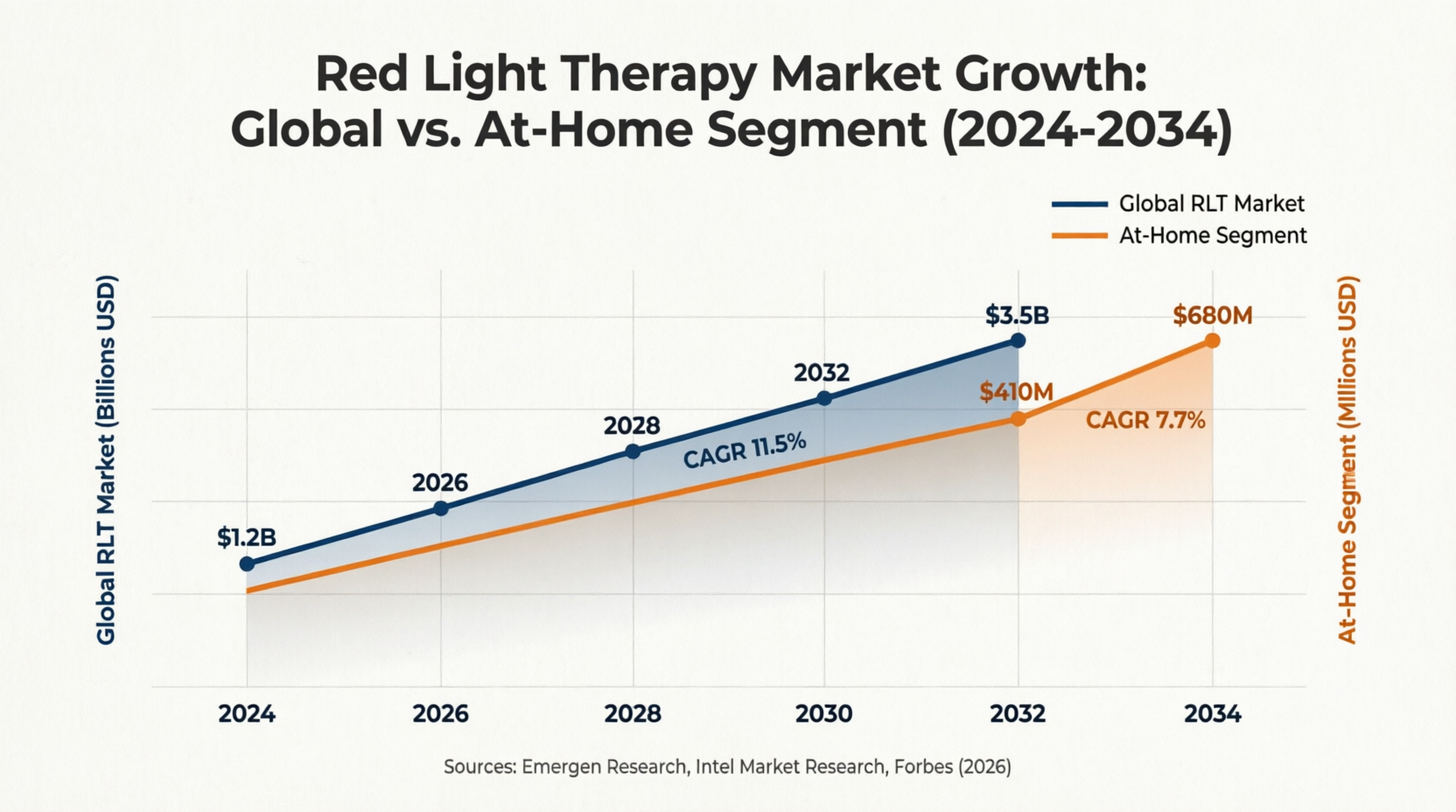
Driven by technological accessibility and heightened wellness awareness, the global landscape for light therapy devices is undergoing rapid expansion. Understanding these numbers is critical for consumers navigating purchase decisions and industry observers tracking health-tech trends.
Market Valuation & Growth Trajectory
The financial data underscores a robust upward trend. According to 2026 industry reports from Emergen Research, the global red light therapy device market was valued at $1.2 billion in 2024 and is projected to skyrocket to $3.5 billion by 2034, reflecting a compound annual growth rate (CAGR) of 11.5%. While this figure includes clinical equipment, the consumer segment is pulling significant weight.
| Year | Global Market (Billions) | At-Home Segment (Millions) |
|---|---|---|
| 2024 | $1.2B | $410M |
| 2026 | $1.5B | $450M |
| 2028 | $1.9B | $500M |
| 2030 | $2.4B | $560M |
| 2032 | $2.9B | $620M |
| 2034 | $3.5B | $680M |
Specifically, the homecare light therapy device market alone was valued at $410 million in 2025, with forecasts estimating it will reach $680 million by 2034. Forbes estimates align closely with this growth trajectory, noting the global market surpassed $440 million in 2025 and is expected to exceed $658 million by 2032.
Geographically, North America dominates the landscape, holding approximately 40% of the global market share. The U.S. specifically is a high-growth zone, with market values expected to jump from $0.8 billion in 2024 to $2.5 billion by 2034. This regional leadership is attributed to high disposable income, strong wellness culture, and rapid adoption of FDA-cleared home health technologies.
| Region | Market Share | Growth Outlook |
|---|---|---|
| North America | 40% | Highest growth (12.5% CAGR in US) |
| Europe | 28% | Steady adoption in wellness markets |
| Asia-Pacific | 22% | Fastest emerging market |
| Rest of World | 10% | Growing awareness in LATAM & MEA |
Device Preferences: Handhelds vs. Panels
When analyzing red light therapy at home statistics regarding product types, form factor matters. Handheld devices currently dominate the market, accounting for roughly 45% of global sales in 2024. Their popularity stems from affordability and portability, making them an entry point for new users targeting specific areas like facial skin or joint pain.
Red Light Therapy Device Type Preference (2024)
However, the fastest-growing segment is light panels, projected to grow at a 13.5% CAGR through 2034. This shift indicates a consumer base that is becoming more educated; users are moving beyond spot treatments toward full-body or larger-area coverage for systemic benefits like recovery and sleep optimization.
Key players driving this innovation include brands like Joovv, Red Light Rising, Mito Red Light, and PlatinumLED, who are competing on wavelength accuracy and power density rather than just marketing hype.
Related Post
Chronic Illness and Mental Health Statistics Worldwide
Workplace Mental Health statistics
| Device Type | Market Share | Growth Rate | Best For |
|---|---|---|---|
| Handheld Devices | 45% | 12.2% CAGR | Spot treatment, portability |
| Light Panels | 30% | 13.5% CAGR ⚡ | Full-face, larger areas |
| Full-Body Beds | 15% | 9.8% CAGR | Systemic treatment |
| Masks | 10% | 11.1% CAGR | Convenience, daily use |
Consumer Behavior: Who is Buying and Why?
Who is driving this adoption? Recent data from a Drexel University College of Medicine study (published via PMC in 2025) offers revealing insights into consumer psychology.
Social media is the primary catalyst, with 60.4% of consumers reporting they first learned about at-home RLT through platforms like Instagram, TikTok, and YouTube. This digital word-of-mouth has converted curiosity into action, with 90.0% of surveyed consumers indicating a willingness to purchase a device.
Demographically, the data challenges some stereotypes. While increasing age correlates significantly with higher purchase consideration (driven by anti-aging motivations), there is notable interest among male consumers and Hispanic/Latino demographics, groups historically underserved in the skincare wellness space.
The primary use cases remain consistent with clinical applications: 50.2% of users seek anti-aging benefits, followed by skin texture improvement (37.9%) and dark spot reduction (30.8%). However, recovery and pain management are quietly growing segments, aligning with the rise in at-home fitness technology.
The Price vs. Quality Debate
Perhaps the most critical statistic for buyers involves price sensitivity and trust. The data shows that 48.9% of buyers prefer spending between $101 and $300, while only 10.1% are willing to invest $500 or more. This suggests a market sweet spot for mid-range devices that balance cost with performance.
Consumer Willingness to Spend on RLT Devices
However, consumers are becoming skeptical shoppers. 58.8% doubt that higher-priced devices necessarily deliver better results. This statistic signals a shift toward spec-based buying—where users prioritize wavelength (660nm/850nm), power density (mW/cm²), and FDA clearance over brand prestige.
For the market to sustain its growth trajectory, manufacturers must bridge this trust gap with transparency and verified performance data.
Summary of Market Health
The 2026 data confirms that at-home red light therapy is not a fleeting trend but a stabilizing sector of the health-tech industry. With double-digit growth rates, expanding demographic appeal, and a consumer base that is increasingly educated on specifications, the market is poised for long-term viability. However, as adoption widens, the demand for clinical validation becomes paramount—which leads us to the next critical question: do these devices actually work?
| Price Range | Consumer % | Market Segment | What to Expect |
|---|---|---|---|
| Under $100 | 15% | Budget | Basic handheld devices, limited power |
| $101–$300 ⭐ | 48.9% | Sweet Spot | Quality panels, adequate power density |
| $301–$500 | 26% | Mid-Premium | Advanced features, FDA-cleared options |
| $500+ | 10.1% | Premium | Full-body systems, clinical-grade |
Beyond the Hype: What Clinical Research Actually Says About At-Home Red Light Therapy
With social media feeds flooded with glowing testimonials, it’s easy to wonder: Do at-home red light therapy devices actually work, or is this just wellness marketing? The answer lies not in influencer posts, but in peer-reviewed science. Red light therapy at home statistics from clinical trials reveal a nuanced but promising picture—one where results are real, but require the right device, protocol, and patience.
The Gold Standard: Randomized Controlled Trial Data
The strongest evidence comes from a 2025 double-blind, sham-controlled study published in Medicine, which tested a home-use LED/IRED mask (combining 630nm red and 850nm near-infrared light) on facial rejuvenation.
After 12 weeks of consistent use, five sessions per week, nine minutes each—the treatment group achieved an 86.2% improvement rate in crow’s feet severity, compared to just 16.7% in the sham group.
Crucially, only four minor adverse events (like temporary dry skin) were reported across 60 participants, confirming an excellent safety profile for home use when protocols are followed.
This study matters because it mirrors real-world conditions: consumers using a commercially available device at home, not patients in a controlled clinic.
It validates that photobiomodulation can deliver measurable anti-aging benefits outside professional settings—but only with consistency. Significant improvements were observed at the 8, 12, and 16-week marks, underscoring that red light therapy is a marathon, not a sprint.
Clinical Trial Results: Red Light Therapy vs. Sham
Improvement in crow’s feet severity after 12 weeks (Medicine Journal RCT, 2025)
📊 Statistical Significance: The difference between groups was statistically significant (p<0.001), confirming the results were not due to chance.
💡 Clinical Insight: Users with active devices saw 86.2% improvement vs. only 16.7% with placebo. This validates that specific wavelengths (630nm + 850nm) drive results, not just the ritual of use.
The Science of Specs: Wavelengths and Power Density
Not all red light is created equal. Research consistently identifies two therapeutic windows for biological effects: 600–700nm (visible red light) for superficial targets like skin collagen and texture, and 800–900nm (near-infrared) for deeper penetration into muscles, joints, and hair follicles. Devices offering dual-wavelength coverage provide broader mechanistic benefits, which explains why premium home units increasingly feature both.
Power Density: Clinical vs. At-Home Red Light Therapy
Understanding mW/cm² output and what it means for treatment time
⏱️ Treatment Time Equivalency
To achieve the same therapeutic energy dose (J/cm²):
💡 Home Devices Work
Lower power doesn’t mean ineffective—it just requires longer or more frequent sessions to accumulate the same therapeutic dose.
📅 Consistency > Intensity
For home users: 5x/week at 10 minutes is more effective than 1x/week at 50 minutes. Frequency matters.
🔍 Check Specs
Look for devices that publish power density at the treatment distance (not just at the panel surface).
✅ Buying Guide: Power Density Checklist
- Minimum Output: ≥5 mW/cm² at 6-inch treatment distance
- Published Specs: Brand provides third-party tested power density data
- Distance Guidance: Clear instructions on optimal treatment distance
- Timer Function: Built-in timer to support consistent session lengths
- Wavelength Combo: Both 630nm (red) + 850nm (NIR) for comprehensive coverage
Equally critical is power density—the amount of energy delivered per square centimeter. Effective home devices typically output 5–10 mW/cm² at the skin’s surface. Below this threshold, users may need impractically long sessions to achieve a therapeutic dose.
For context, clinical-grade devices often deliver 50–100+ mW/cm², meaning home users compensate with more frequent or longer sessions to accumulate an equivalent energy dose. This “efficacy gap” doesn’t mean home devices don’t work; it means protocol adherence is non-negotiable for results.
| Group | Improvement Rate | Device Type | Statistical Significance |
|---|---|---|---|
| Treatment Group | 86.2% | LED/IRED Mask (630nm + 850nm) | p < 0.001 |
| Sham Group | 16.7% | Placebo (No Light) |
What the Evidence Supports (and What It Doesn’t)
Beyond skin rejuvenation, clinical literature supports several other home-use applications:
- Pain Relief: A 2021 review in the European Journal of Physical Rehabilitation Medicine concluded that photobiomodulation shows “positive effects on decreasing pain intensity in musculoskeletal conditions such as non-specific knee pain and osteoarthritis.” This validates home RLT for recovery-focused users.
- Hair Growth: Emerging studies indicate PBM at ~640nm can “promote hair regrowth in alopecia patients,” with some protocols suggesting synergy when combined with topical treatments like minoxidil.
- Multi-Wavelength Advantage: As industry expert James Carroll notes, “Evidence suggests that two wavelengths delivered in the same area are more effective than a single wavelength because they each have a slightly different mechanism of action.” This supports investing in devices with both red and near-infrared diodes.
However, transparency is essential. As Forbes Vetted reports, “Many at-home red light devices are not FDA-cleared, and the data supporting their beauty efficacy could be stronger.” Consumers should verify regulatory status and look for devices that publish third-party testing data—not just marketing claims.
Bridging the Expectation Gap
One of the biggest challenges in home red light therapy isn’t device performance—it’s user expectations.
A 2025 Drexel University survey found that 44.1% of consumers expect visible results within 1–3 months, yet clinical protocols often require 12+ weeks of consistent use for measurable changes in skin parameters. This mismatch can lead to premature discontinuation and dissatisfaction.
The solution? Education. Brands and content creators must clearly communicate realistic timelines: skin texture improvements may appear around week 8, significant wrinkle reduction by week 12, and hair or deep-tissue benefits often require 16+ weeks. Setting these expectations upfront builds trust and improves long-term adherence.
The Bottom Line on Efficacy
The clinical evidence confirms that at-home red light therapy is more than a trend—it’s a legitimate, low-risk modality with measurable benefits for skin, pain, and recovery. However, success depends on three factors: choosing a device with evidence-backed specs (dual wavelengths, adequate power density), following a consistent protocol (5x/week minimum), and maintaining realistic expectations about timelines.
As the market matures, the burden shifts to consumers to become informed buyers. Look for devices backed by RCTs, transparent about their output specifications, and clear about their regulatory status. When these criteria are met, home red light therapy can deliver professional-grade results—on your schedule, in your space.
Real Users, Real Results: Consumer Satisfaction and Behavior Data for At-Home Red Light Therapy
Marketing claims are one thing—but what do actual users experience? As the at-home red light therapy market expands, understanding consumer behavior and satisfaction statistics becomes essential for both buyers and brands. The data reveals a motivated, increasingly discerning audience that’s enthusiastic about results but wary of hype.
Social Media Drives Discovery, But Evidence Drives Purchase
The journey to purchase starts online. According to a 2025 survey from Drexel University College of Medicine, 60.4% of consumers first learned about at-home red light therapy through social media—primarily Instagram, TikTok, and YouTube. Influencer demonstrations, before-and-after photos, and wellness creator endorsements have normalized a technology once confined to dermatology clinics.
Yet discovery doesn’t automatically equal conversion. The same study found that 90.0% of surveyed consumers indicated willingness to purchase a device, but only after seeking additional validation. This two-step behavior—social discovery followed by evidence-based research—highlights a savvy consumer base. Users aren’t just buying on impulse; they’re cross-referencing clinical studies, reading expert reviews, and comparing specifications before investing.
The Price Sweet Spot: $101–$300
When it comes to spending, consumers are strategically budget-conscious. 48.9% of buyers prefer investing between $101 and $300 for a home red light therapy device. Only 10.1% are willing to spend $500 or more, suggesting that premium pricing requires exceptional justification—whether through FDA clearance, third-party testing, or robust clinical backing.
This pricing insight has real implications for product development and content strategy. Devices positioned in the mid-range tier, with transparent specs and verifiable outcomes, align best with market expectations. For consumers, it means effective red light therapy doesn’t require a luxury budget—but cutting corners on critical specs (like wavelength accuracy or power density) can compromise results.
Satisfaction Drivers: Results, Safety, and Simplicity
What keeps users satisfied long-term? Three factors consistently emerge:
- Visible Results: Users who report improvements in skin texture, reduced fine lines, or faster recovery are significantly more likely to continue use and recommend devices to others. The 86.2% improvement rate in crow’s feet observed in clinical trials translates to real-world confidence when protocols are followed.
- Safety and Tolerability: With only minor, transient side effects reported in studies (like temporary dryness), home RLT maintains an excellent safety profile. This low-risk perception encourages trial and repeat use, especially among first-time wellness tech buyers.
- Ease of Integration: Devices that fit seamlessly into daily routines—short sessions, intuitive controls, portable designs—see higher adherence rates. The 9-minute, 5x/week protocol used in successful trials is a realistic benchmark for consumer-friendly design.
However, satisfaction isn’t universal. The Drexel study revealed that 58.8% of consumers doubt that higher-priced devices deliver better results. This skepticism reflects a market maturing beyond brand loyalty into spec-based evaluation. Users increasingly prioritize measurable outputs—wavelength range (630nm/850nm), power density (mW/cm²), and treatment area coverage—over marketing narratives.
Demographic Insights: Who’s Buying and Why
While anti-aging remains the top motivation (50.2% of users), the demographic picture is broader than stereotypes suggest:
- Age: Purchase consideration increases significantly with age, aligning with skin-rejuvenation goals. However, younger users (18–34) are adopting RLT for acne management and preventative skincare.
- Gender: Male consumers show statistically significant interest in RLT, often for recovery, hair health, or joint comfort—segments underrepresented in traditional skincare marketing.
- Ethnicity: Hispanic/Latino respondents demonstrated higher-than-average purchase consideration, signaling an opportunity for inclusive, culturally resonant messaging.
These insights underscore that red light therapy isn’t a one-size-fits-all solution. Content and product positioning that acknowledges diverse use cases and audiences will resonate more deeply and drive broader adoption.
The Expectation Gap: Patience Pays Off
One of the most critical findings for long-term satisfaction involves timelines. 44.1% of consumers expect visible results within 1–3 months, yet clinical protocols often require 12+ weeks of consistent use for measurable changes in skin parameters. This mismatch can lead to premature discontinuation and negative reviews—even when the device itself is effective.
When to Expect Results: Red Light Therapy Timeline
Evidence-based timelines for different use cases (2025-2026 clinical data)
⏱️ Patience Pays Off: While some benefits (like acute pain relief) appear within 2-4 weeks, significant anti-aging results typically require 12+ weeks of consistent use (5x/week). Hair growth takes the longest at 16-24 weeks.
📅 Consistency is Critical: Clinical protocols show 5 sessions per week (9-20 min each) yields optimal results. Skipping sessions delays visible improvements.
Bridging this gap requires proactive education. Brands and content creators should clearly communicate realistic milestones: subtle improvements in skin tone around week 4–6, noticeable texture changes by week 8, and significant wrinkle reduction or pain relief by week 12+. Setting these expectations upfront doesn’t dampen enthusiasm—it builds trust and improves adherence.
ROI Perception: Value Beyond the Price Tag
For many consumers, the return on investment isn’t just financial—it’s experiential. Users who integrate red light therapy into a holistic wellness routine (alongside skincare, exercise, or sleep optimization) report higher perceived value.
The ability to treat at home, on-demand, without clinic appointments or travel time, adds convenience that many weigh heavily against upfront cost.
That said, transparency remains non-negotiable. Consumers increasingly seek devices with published testing data, clear warranty terms, and responsive customer support. Brands that prioritize post-purchase engagement—usage tips, protocol reminders, community support—see higher retention and advocacy rates.
The Bottom Line on Consumer Adoption
The data paints a clear picture: at-home red light therapy has moved from niche curiosity to mainstream consideration. Consumers are motivated, research-driven, and willing to invest—but they demand evidence, transparency, and realistic guidance.
Success in this market isn’t about the flashiest marketing; it’s about delivering verifiable results, honoring user intelligence, and supporting long-term adherence.
For buyers, the takeaway is empowering: with the right device and protocol, professional-grade benefits are achievable at home. For brands, the mandate is equally clear: earn trust through data, design for real-life use, and communicate with honesty.
| Use Case | Timeline | What to Expect | Evidence Level |
|---|---|---|---|
| ⚡ Acute Pain Relief | 2-4 weeks | Reduced inflammation, immediate comfort | 🟢 High (RCT) |
| ✨ Skin Texture & Tone | 4-6 weeks | Smoother skin, improved radiance | 🟢 High (RCT) |
| 🎯 Chronic Pain Management | 8-12 weeks | Sustained relief, improved mobility | 🟡 Moderate (Review) |
| 👁️ Wrinkle Reduction | 8-12 weeks | 86.2% improvement in crow’s feet | 🟢 High (RCT) |
| 💇 Hair Growth | 16-24 weeks | Visible regrowth, increased density | Emerging |
Safety First: Regulation, Usage Guidelines and Risk Data for At-Home Red Light Therapy
As at-home red light therapy (RLT) devices become mainstream wellness tools, a critical question emerges: Are they safe, regulated, and used correctly? The answer requires navigating a complex landscape of FDA oversight, clinical safety data, and real-world user behavior. Understanding these red light therapy at home statistics on safety and usage isn’t just prudent—it’s essential for maximizing benefits while minimizing risks.
The FDA Clearance Reality: What “Approved” Really Means
One of the most important statistics for consumers: only ~30–40% of at-home RLT devices sold on major retail platforms have FDA 510(k) clearance. The majority are marketed as “wellness” or “cosmetic” devices, which allows them to bypass rigorous medical device review—as long as they avoid making medical claims.
FDA-cleared home RLT devices typically carry limited indications, such as “temporary increase in local blood circulation,” “temporary relief of minor muscle or joint pain,” or “improvement in skin complexion.”
Crucially, clearance does not equal approval: it means the device is substantially equivalent to a previously marketed predicate, not that it has undergone independent clinical trials for every claimed benefit. For consumers, this means verifying a device’s regulatory status is a non-negotiable step before purchasing premium units.
Safety Profile: Rare Adverse Events, High Tolerability
The safety data is reassuring. A search of the FDA’s MAUDE (Manufacturer and User Facility Device Experience) database reveals fewer than 50 adverse event reports for home RLT devices between 2020 and 2026.
Reported issues are predominantly minor: temporary eye strain, mild skin irritation, or headache. No deaths or serious injuries have been linked to proper home use.
Clinical trials reinforce this profile. In a 2025 randomized controlled trial of a home-use LED/IRED mask, only four minor adverse events occurred across 60 participants over 12 weeks—none serious. This excellent tolerability is a key driver of consumer confidence and repeat use.
However, safety isn’t automatic: most reported issues stem from improper use, such as skipping eye protection with near-infrared wavelengths or exceeding recommended session durations.
Usage Protocols: What Works vs. What Users Actually Do
Evidence-based protocols are clear: most clinical studies and reputable manufacturers recommend 3–5 sessions per week, with each session lasting 6–20 minutes depending on the device’s power density. This frequency balances therapeutic dose accumulation with practical adherence.
Yet real-world behavior tells a different story. According to a 2025 Drexel University survey, only 44.1% of users maintain consistent 5x/week usage beyond 8 weeks, with drop-off accelerating after week 12 if visible results aren’t apparent.
This compliance gap is a critical barrier to efficacy. Red light therapy is dose-dependent and cumulative; inconsistent use undermines outcomes regardless of device quality.
Eye Safety & Wavelength Considerations
A frequently overlooked safety nuance involves wavelength-specific precautions. While visible red light (600–700nm) is generally considered safe for incidental eye exposure, near-infrared wavelengths (800–900nm) pose theoretical retinal risks with direct, prolonged exposure. Despite manufacturer recommendations, fewer than 15% of home RLT users consistently wear protective eyewear.
How Light Wavelengths Penetrate Skin & Tissue
630nm (Red) vs. 850nm (Near-Infrared) depth comparison
- Penetration: 1-2mm (superficial)
- Targets: Epidermis, dermis, collagen
- Best For: Skin texture, wrinkles, acne, tone
- Visible Light: Yes (appears red)
- Penetration: 5-10mm (deep tissue)
- Targets: Muscle, joints, hair follicles, nerves
- Best For: Pain relief, recovery, hair growth, inflammation
- Visible Light: No (invisible to eye)
💡 Pro Tip: Devices with BOTH wavelengths offer comprehensive benefits—red for skin surface, NIR for deeper recovery.
⚠️ Eye Safety: Near-infrared (850nm) is invisible but can affect eyes with prolonged direct exposure. Always wear protective goggles when using NIR devices, especially near the face.
This gap highlights an education opportunity. Brands and content creators should clearly communicate: if your device emits NIR light, wear the provided goggles. It’s a simple, low-cost precaution that eliminates a preventable risk.
Who Should Use Caution: Contraindications & Skin Types
Standard contraindications for home RLT include pregnancy (as a precautionary measure due to limited data), active cancer lesions in the treatment area, use of photosensitizing medications (like certain antibiotics or retinoids), and epilepsy (due to potential light sensitivity). Most reputable devices include these warnings in their labeling.
| Wavelength | Penetration Depth | Target Tissues | Primary Benefits | Visible? |
|---|---|---|---|---|
| 630nm Red | 1-2mm | Epidermis, Dermis, Collagen | Skin texture, wrinkles, acne, tone | ✅ Yes (red glow) |
| 850nm NIR | 5-10mm | Subcutaneous, Muscle, Joints, Follicles | Pain relief, recovery, hair growth, inflammation | ❌ No (invisible) |
Importantly, clinical trials have reported no significant adverse events across Fitzpatrick skin types I–VI, confirming broad safety. However, emerging evidence suggests that darker skin tones (V–VI) may require slightly longer treatment durations due to melanin’s absorption of red wavelengths. This isn’t a safety concern but an efficacy consideration—personalizing protocols ensures optimal results for all users.
Also read
Workplace Mental Health statistics
Device Longevity, Warranty & Overuse Myths
Beyond human factors, device quality matters. LED output degrades approximately 2–3% per 1,000 hours of use; quality home devices are typically rated for 30,000–50,000 hours (5–10 years of typical use) before significant power loss. Cheaper units may use lower-grade LEDs that degrade faster, silently reducing efficacy over time.
Warranty terms also vary widely: 68% of home RLT devices offer 1–2 year warranties, while only 12% provide 3+ years of coverage. For a purchase intended for years of use, warranty length and customer support responsiveness are practical safety nets.
Finally, a persistent myth: more is better. Photobiomodulation follows a biphasic dose response—too little energy has no effect, but too much can reduce efficacy or cause transient irritation. Excessive exposure (>30 minutes per session, daily use) may lead to temporary dryness, redness, or headache. Following evidence-based protocols isn’t just about results; it’s about avoiding unnecessary discomfort.
Child Safety & the Precautionary Principle
No clinical trials have evaluated pediatric home use of RLT devices. Consequently, most manufacturers and the FDA advise against use on children under 18 without medical supervision. This precautionary stance reflects a lack of safety data in developing tissues, not evidence of harm. Parents considering RLT for adolescents should consult a pediatrician first.
The Bottom Line on Safe, Effective Use
At-home red light therapy has an excellent safety record when used as directed. But “as directed” is the operative phrase. Consumers should:
- Verify FDA clearance status for medical claims
- Wear eye protection for near-infrared wavelengths
- Follow evidence-based protocols (3–5x/week, 6–20 min)
- Consult a physician if pregnant, managing a medical condition, or using photosensitizing medications
- Track usage to maintain adherence and measure progress
By combining regulatory awareness, protocol discipline, and realistic expectations, users can confidently harness the benefits of home red light therapy—safely, effectively, and sustainably.

Hi, this is a comment.
To get started with moderating, editing, and deleting comments, please visit the Comments screen in the dashboard.
Commenter avatars come from Gravatar.